November 16, 2023, 4 min read, by Vinicius Bastos
mmWave Sensor: What It Is and How It Saves Energy
An mmWave sensor is a radar presence sensor that even detects people sitting still. See how it works, where to use it, and how it saves on lights and AC.
A common problem in homes and offices is wasted energy from equipment left on unnecessarily.
At night, we see buildings with lit rooms and air conditioners running with no one there.
At home, it's common for someone to forget to turn off a device.
This problem gets worse when the family goes on a trip or the office is closed over the weekend and, on returning, they find that the lights, the air conditioning, or even an electric oven was on the whole time.
With the cost of electricity getting higher and higher, it's worth investing in an automation system that turns equipment off when there's no one in the room.
The infrared motion sensor, which is popular in alarm systems, works for detecting an initial movement, but it isn't precise enough to detect micromovements, such as a head moving or even the chest rising and falling with each breath.
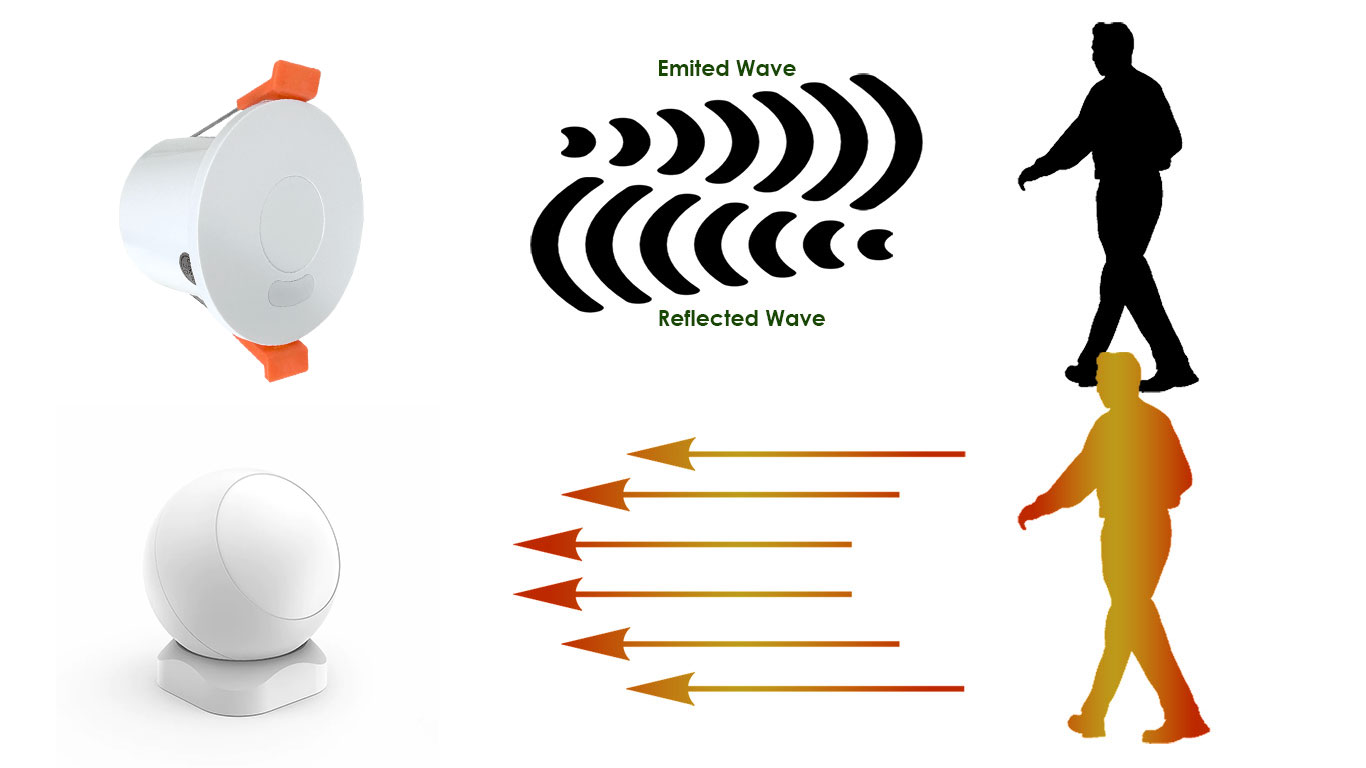
This lack of precision prevents this type of sensor from being used to turn off equipment when it detects no movement. If someone is sitting on the couch watching TV or working at the computer, the infrared sensor probably won't detect the micromovements and will turn off the equipment when it shouldn't.
That's where millimeter-wave radar technology, called mmWave, comes in.
What is an mmWave sensor?
An mmWave sensor is a radar presence sensor: it emits high-frequency radio waves and reads their reflection to sense movement, even the subtlest, such as the chest of someone breathing. That's why it detects people who are still, sitting, or sleeping, and not just those passing by.
The name comes from "millimeter wave." According to Texas Instruments, a radar chipmaker, these are waves from 30 to 300 GHz, with wavelengths of 1 to 10 millimeters; in practice, 24 GHz presence sensors also go by that name.
This technology is used in vehicle parking sensors, autonomous driving systems, security systems, and home automation.
Since it doesn't use a camera, the radar doesn't record images, and it works even behind a plastic cover. That's why it's already showing up built into light fixtures, air conditioners, and locks, among other devices. Texas Instruments mentions, for example, the air conditioner that turns itself off when it doesn't detect anyone in the room for a long time.
How does an mmWave presence sensor work?
The radar emits waves, usually from 24 GHz up, and when they return to the sensor, the algorithm calculates the distance to the object in question.
The sensor's sensitivity can be adjusted so that it detects small movements, such as those of a person breathing.
There are 24 GHz and 60 GHz sensors. According to Seeed Studio, which makes radar modules in both bands, the 24 GHz sensor reaches farther and gets through obstacles better, and the 60 GHz sensor is more precise, suited to applications such as fall detection.
Besides sensitivity, it's essential to adjust the timeout the sensor waits before concluding that no one is in the room.
With a timeout of 60 seconds, for example, the chance of the sensor not detecting any movement is small, especially in places like offices, bedrooms, and living rooms.
Because it's so sensitive, this type of sensor can trigger falsely: a fan, an air conditioner blowing directly on the sensor, vibrations, airflow, and even glass walls can cause interference.
That's why it's essential to study the location before installing the sensor.
Where to use an mmWave sensor
Another important point is to use the sensor for its main application, and not as a regular motion sensor.
Because it's more sensitive and has many adjustable parameters, the millimeter-wave sensor isn't the best choice for simple motion detection, such as someone walking down a hallway.
For that application, the infrared sensor is a better fit.
But in an elevator lobby, for example, the mmWave sensor is perfect, because it won't turn off the light while someone is waiting for the elevator to arrive.
There are many applications: kitchens, bedrooms, living rooms, offices, gyms, common areas in buildings, and much more.
In short: infrared is ideal for detecting people arriving or passing by, and mmWave is ideal for confirming that someone is still in the room. In an energy-saving scene, mmWave is what ensures the lights and air conditioning are only turned off when the room is really empty.
Watch the video and meet the QA mmWave sensor.