April 28, 2022, 6 min read, by Vinicius Bastos
Movie Theater Screens: Size, IMAX, Projector or TV at Home
How big a movie screen is, up to the world's largest IMAX, and how to choose a projector or TV at home, plus the right screen and projector for the room.
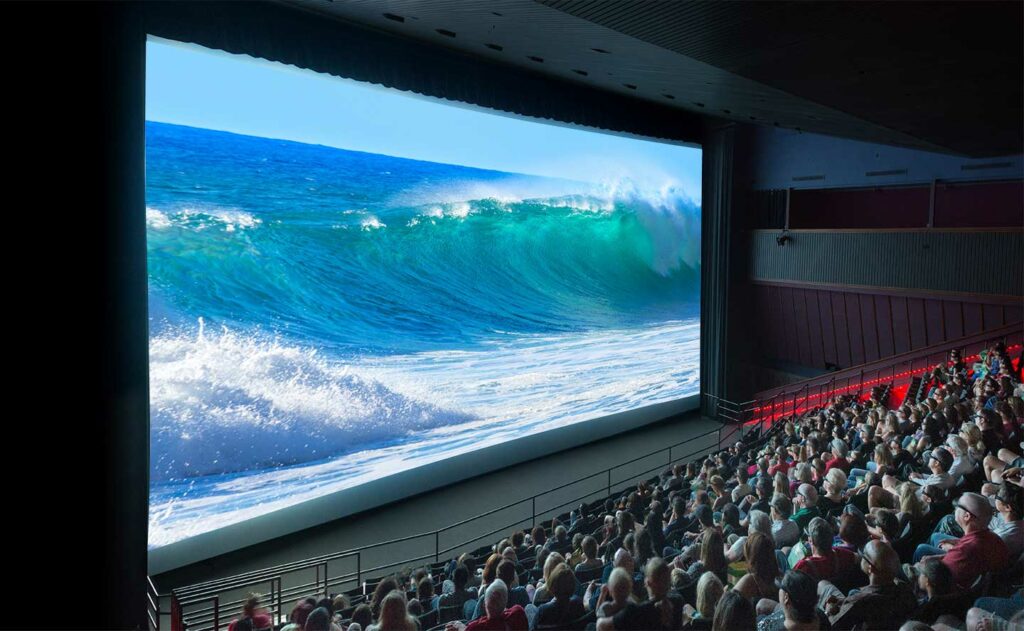
Have you ever watched a movie in the Samsung Onyx 4K theater, opened in 2019 at the Cinépolis in Shopping JK Iguatemi, in São Paulo?
The theater is equipped with a 455" modular display, the first movie theater without projection in Brazil.
At the same venue, you will find the IMAX theater, which uses technology developed to maximize viewer immersion, in both audio and video.
These are two technologies for the same application: one has a modular display, and the other uses projection technology.
One thing is certain: the experience on a giant screen is unbeatable.
The difference in screen size in an IMAX theater is so big that fun is guaranteed.
When I go to the movies, I go to have fun and relax.
I prefer the IMAX theater.
I am not worried about black levels, contrast, pixels or brightness: I want to enjoy the movie and have a pleasant experience.
Speaking specifically of IMAX, the aspect ratios are 1.90:1 or 1.43:1, different from the traditional 16:9 of TVs. Movies need to be shot or adapted to be shown in this format.
How big is a movie theater screen?
There is no standard size: a movie theater screen is sized to the width and depth of each auditorium. The LED screen in the Onyx theater at JK Iguatemi, for example, measures 455 inches, or 55 m², according to Samsung.
In December 2022, Guinness recognized an IMAX screen as the largest permanent cinema screen in the world: the one at the Traumpalast cinema in Leonberg, Germany, measuring 38.80 m by 21 m, or 814.8 m².
What about the IMAX projector?
In IMAX with Laser theaters, the image comes from a 4K laser projection system with a new optical engine, which increases resolution and contrast, according to the Australian chain Event Cinemas. In Brazil, the first theater with this technology was precisely the one at Cinépolis JK Iguatemi, which became IMAX with Laser in January 2024, with 12 sound channels, according to Jornal de Brasília.
At home, you can watch some movies in the IMAX format: in November 2021, Disney+ began offering Marvel movies in the expanded 1.90:1 aspect ratio, with up to 26% more picture in selected scenes, according to Disney. The selection of titles varies from country to country.
But what about the home theater?
At home, I have a Panasonic PT-AE8000 1080p projector, which delivers a great picture on a 110" screen.
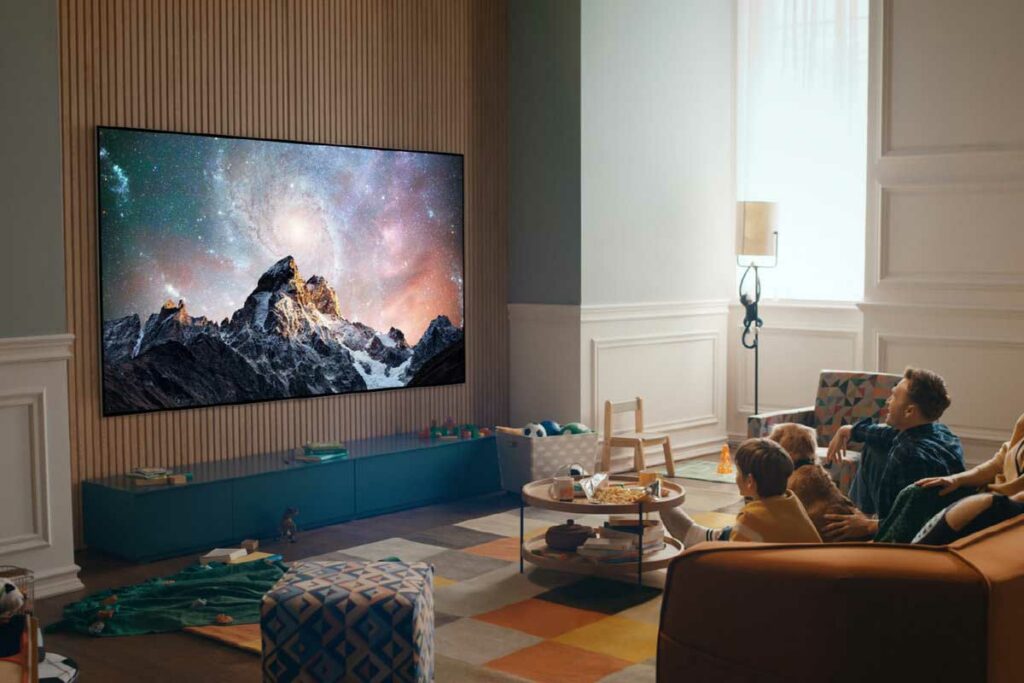
I also have a 65" LG OLED evo TV, which has the best picture I have ever seen on a TV.
Which one do I prefer?
Although I love my projector home theater, the LG OLED evo TV's picture is eye-popping.
Completely deep blacks, just the right brightness, and it also has Dolby Vision technology, found in movies and series on Disney+ and Netflix.
We cannot leave price out of the equation.
In 2022, when I wrote this post, an 85" 8K TV cost more than a great projector and a 110" screen, and a 65" 4K TV was more affordable than the projector and screen.
How to decide?
Projector or TV? How the room is used is the deciding factor: for a dedicated, dark room, the projector; for a multipurpose room, open to another space, the TV.
Since the projected image has no brightness of its own, even with screens that minimize the problem, projectors work best in dark rooms.
Is it a dedicated room? In that case, I recommend a projector. Just like in IMAX, the immersion is superior, and you can also install the speakers behind the screen if it is acoustically transparent!
An alternative for a dedicated home theater is Samsung's The Wall, which has the advantage of increasing the resolution as the screen size increases.
Another option, for both dedicated and multipurpose rooms, is ultra short throw (UST) projection. These projectors sit very close to the screen and deliver a spectacular picture on screens up to 120", without the problems of a giant TV, such as transport, space and weight.
How to choose the screen and projector for your home
Start with the screen size, which depends on the distance to the couch. A rule of thumb from Samsung for TVs, which also works as a reference for a projector screen, is to divide that distance, in centimeters, by 3: the result is the recommended size in inches. At 3 meters from the couch, for example, the screen comes out at around 100".
Then look at these points:
Screen type: fixed, with a frame and stretched fabric, for a dedicated room; retractable and motorized, which comes down only when it is movie time, for a multipurpose room. A motorized screen can be part of an automated movie scene, along with the lights and the projector.
Ambient light: for rooms with light, there are ambient light rejecting (ALR) screens, which reflect the projector's light back to the audience and deflect light coming from other directions. According to manufacturer Stewart Filmscreen, they only work if the room light does not reach the screen from the same direction as the projector's light.
Speakers behind the screen: an acoustically transparent screen uses a woven or perforated fabric that lets sound through, and allows the front speakers, including the center channel, to be installed behind it.
Projector distance: it depends on the throw ratio, which is the distance divided by the image width. With a 1.13:1 ratio, the most common according to BenQ, a 100" image calls for the projector to be about 2.5 m from the screen; ultra short throw models produce the same image from about 1 m from the wall, or less.
Brightness: compare ANSI lumens, measured at several points of the projected image. The "light source lumens" that some ads highlight give higher numbers because they do not account for the brightness lost inside the projector, as BenQ explains.
Conclusion
Do you have a dedicated home theater? I recommend going with an excellent projector and a 110" or larger screen. You will certainly get the best immersion and, together with a properly sized audio system, you will enjoy your movies and series as if you were at the movies.
For all other cases, I recommend a TV. If you have kids at home and use YouTube, want to control it through Alexa or Google, turn the TV on and off often and still want an eye-popping picture, the TV is the best option.
Beyond audio and video, I recommend investing in an automation solution for lighting and multiroom audio.