September 29, 2025, 6 min read, by Vinicius Bastos
Series and Parallel Wiring: How to Connect Speakers
Series and parallel wiring made simple: how impedance adds up or drops, what two 8-ohm speakers in parallel give you, and how to wire speakers to an amp.
If you're putting together a sound system, whether for events, commercial venues, or a home theater, understanding how to connect the speakers correctly is essential to get the best performance from the amplifier and avoid damaging the equipment.
What are series and parallel connections?
In a series connection, the components sit one after the other, along a single path: the same current flows through all of them, and the resistances (or the impedances, in the case of speakers) add up. In a parallel connection, each component is connected to the same two points: all of them receive the same voltage, and the total resistance is lower than the smallest one.
The rule applies to any load, whether a resistor, a light bulb, or a speaker, and it's what is taught as series and parallel combinations:
In series: the values add up (R = R1 + R2 + ...). If one component opens, the whole circuit stops, like old Christmas lights, which went completely dark when one bulb burned out.
In parallel: the reciprocals add up (1/R = 1/R1 + 1/R2 + ...). With identical components, just divide the value of one of them by the number of components; with two different ones, the result is the product divided by the sum. If one opens, the others keep working: that's how the lights and outlets in a house are wired, each one receiving the line voltage.
For speakers, the value that goes into these calculations is the impedance, in ohms (Ω), and the result is the load the amplifier will "see" on each channel.
The example: QA 2-Zone Amplifier
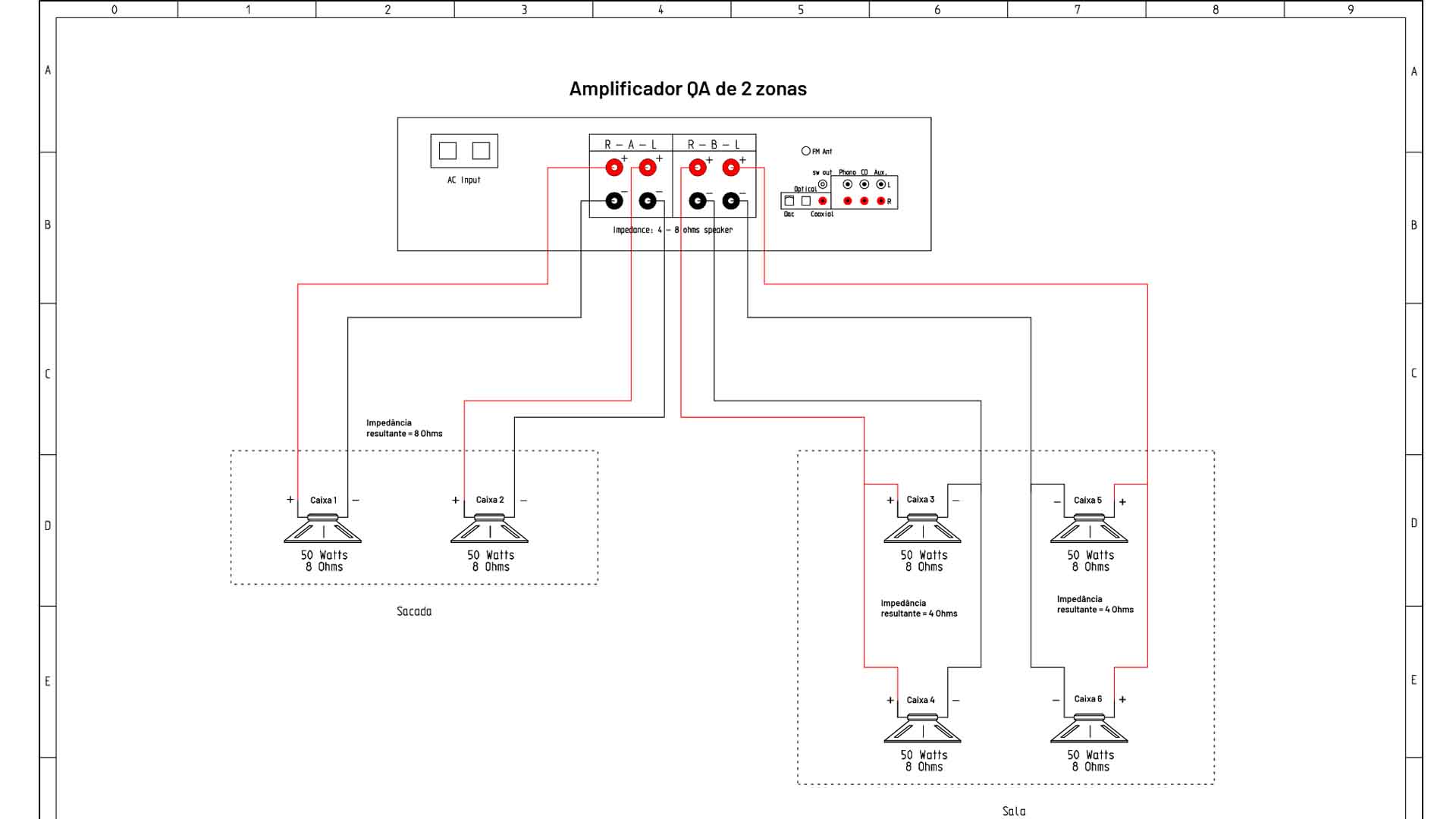
We'll use as a reference a 4-channel amplifier, each channel rated at 50 W and supporting impedances from 4 to 8 ohms. The system is divided into two zones:
Zone A (Balcony): each channel (left and right) is connected to a single 8-ohm speaker, and the resulting impedance is 8 ohms per channel.
Zone B (Living room): each channel has two 8-ohm speakers connected in parallel, which results in an impedance of 4 ohms per channel.
Types of connection
1. Series connection
In a series connection, the speakers are connected one after the other, like the cars of a train: the amplifier's positive goes to the positive of the first speaker, that speaker's negative goes to the positive of the second, and the negative of the second goes back to the amplifier's negative. The signal passes through the first speaker and then through the second.
Impedance calculation: the impedances add up
Example: two 8 Ω speakers in series = 16 Ω
Advantage: increases the total impedance, protecting the amplifier from overload
Disadvantage: reduces the power delivered to the speakers and the volume
Caution: if one speaker blows or a wire comes loose, the circuit opens and all the speakers in the series go silent
2. Parallel connection
In a parallel connection (as in Zone B of our example), all the speakers receive the signal at the same time, with the positive terminals connected together and the negatives joined as well.
Impedance calculation: for identical speakers, divide the impedance by the number of speakers; for different speakers, the resulting impedance of two speakers is the product divided by the sum (Z1 × Z2 ÷ (Z1 + Z2))
Example: two 8 Ω speakers in parallel = 4 Ω; one 8 Ω speaker with one 4 Ω speaker = 32 ÷ 12, about 2.7 Ω
Advantage: the lower impedance allows more power and volume
Disadvantage: overloads the amplifier if the impedance falls below the minimum it supports
3. Series-parallel connection (combined)
This configuration combines both techniques, creating groups of speakers in series that are then connected in parallel (or vice versa).
Example: with four 8 Ω speakers, make 2 pairs in series (16 Ω each) and connect them in parallel = 8 Ω total
Advantage: lets you connect several speakers while keeping the impedance at a suitable level
Ideal for: systems with many speakers
How to connect two speakers in parallel
Connect the positive (+) of the amplifier output to the positive of both speakers and the negative (-) to the negative of both. The wires can run from the amplifier directly to each speaker, or from the amplifier to the first speaker and from there to the second, as long as it's always positive to positive and negative to negative.
Before connecting, check the resulting impedance and the minimum the amplifier accepts, which is given on the spec sheet and, on many units, next to the speaker terminals.
What do two 8-ohm speakers in parallel equal?
Two 8-ohm speakers in parallel give you 4 ohms. One 8-ohm speaker with one 4-ohm speaker gives about 2.7 ohms (8 × 4 ÷ 12), which is below the minimum of many amplifiers, and the 4-ohm speaker gets twice the power of the other one.
The most common combinations:
Two 8 Ω speakers in series: 16 Ω
Two 8 Ω speakers in parallel: 4 Ω
One 8 Ω speaker and one 4 Ω speaker in parallel: about 2.7 Ω
Two 4 Ω speakers in parallel: 2 Ω
Four 8 Ω speakers in parallel: 2 Ω
Four 8 Ω speakers in series-parallel (two pairs in series, connected in parallel): 8 Ω
To connect 4 speakers to 2 outputs, as on a stereo amplifier, the usual approach is to put 2 speakers on each channel: with 8 Ω speakers, that's 4 Ω per channel in parallel, as in Zone B of the example, or 16 Ω in series.
What impedance means for the amplifier
Higher impedance (8 ohms, Zone A):
Less electrical current flows through the amplifier
The amplifier runs "cooler" and safer
The power delivered is lower (but within specifications)
Longer equipment life
Slightly lower volume
Lower impedance (4 ohms, Zone B):
More electrical current flows through the amplifier
The amplifier works closer to its limit
Maximum power is delivered to the speakers
Higher volume
The amplifier heats up more
WARNING: never use an impedance below the minimum specified by the manufacturer, as this can permanently damage the amplifier!
Resulting impedance in the example
Our 4-channel amplifier is configured with different impedances in each zone, but both are within the safe operating range (4 to 8 ohms):
Zone A channels: 8 Ω (conservative, safe operation)
Zone B channels: 4 Ω (maximum power within limits)
This configuration is completely safe and takes advantage of the amplifier's flexibility: Zone A prioritizes durability and lower consumption, while Zone B maximizes volume for a larger room.
What about when there are many speakers?
In stores, restaurants, and common areas, with dozens of speakers and long cable runs, the combinations above become hard to work out. In these cases, a constant-voltage line system (70 V or 100 V) is used, with an amplifier made for it and a transformer in each speaker, which lets you choose the power of each one. There, instead of calculating impedance, you add up the power selected on all the speakers, and the total must stay below the amplifier's power, with some headroom for transformer losses.
Tip
Always check your amplifier's specifications before connecting the speakers. Respecting the impedance limits is essential to ensure sound quality, safety, and equipment durability!
Also respect polarity: positive to positive and negative to negative, on every speaker. A speaker with its wires reversed works "backwards" relative to the others, and the sound loses bass.
To choose the speakers and amplifier for a home project, also see multiroom audio.