March 3, 2024, 11 min read, by Vinicius Bastos
Types of LED Strip Lights: Models, Width and Wattage
LED strip types: SMD or COB, single color, CCT or RGB, width, watts and lumens per meter, 12 or 24 V power supply and which to use as main lighting.
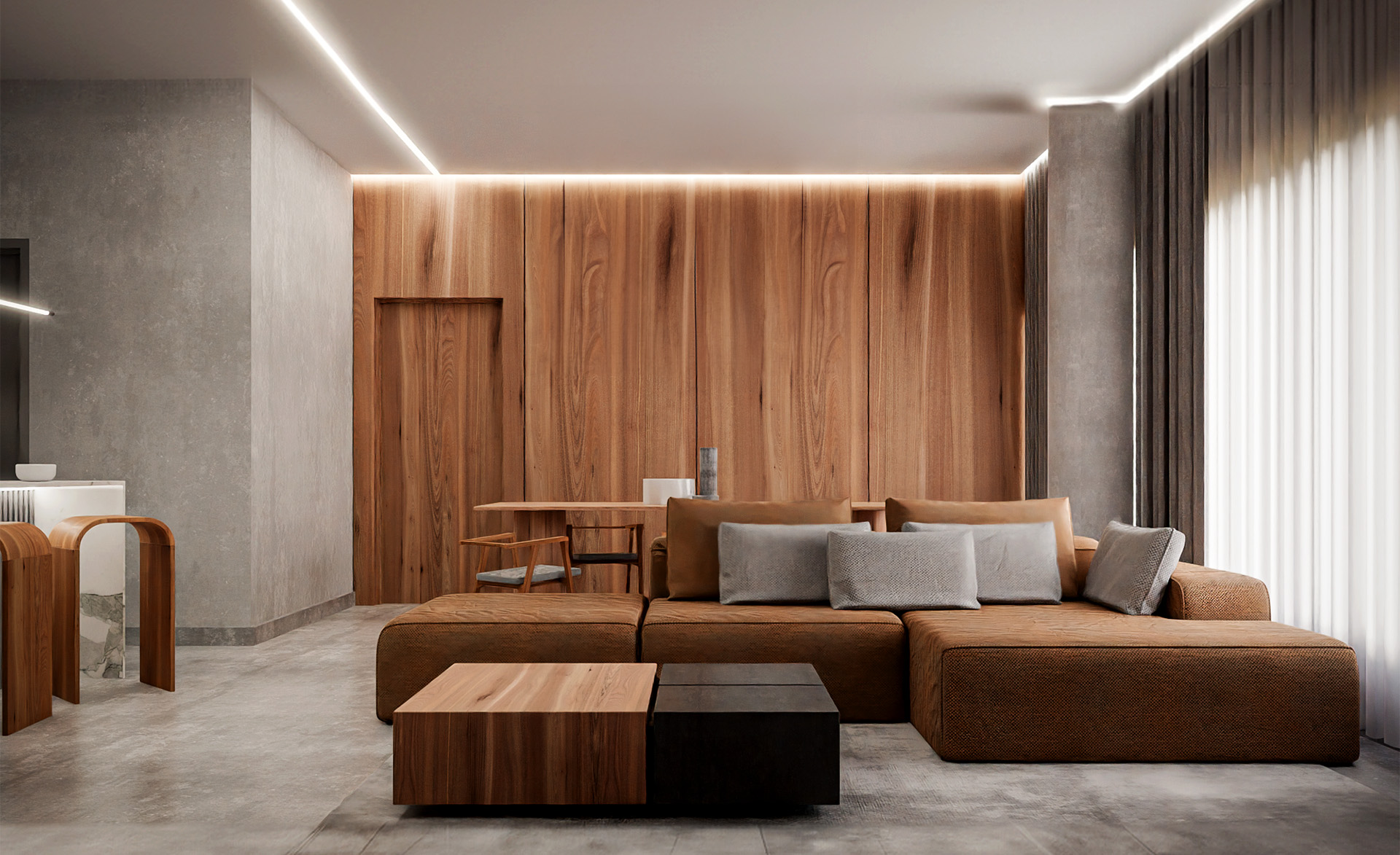
LED strips are a type of lighting that is finding its way into more and more projects.
Once used only for decoration, they have now become a great option for the main lighting of a room. This evolution brings with it the need to better understand their characteristics and possibilities.
These versatile light sources are made up of a series of LEDs (Light Emitting Diodes) mounted on a flexible circuit board.
Their key characteristics include operation on direct current, usually at 12 V or 24 V, PWM (Pulse Width Modulation) control for adjusting intensity, and sale in reels that can be cut to the desired length.
What are the types of LED strip lights?
LED strip types are divided by four characteristics: the LED technology, the color of the light, the supply voltage and the protection against water. When buying, you choose one option from each group:
Technology: SMD, with the LEDs visible as dots (chips such as the 2835 and the 5050), or COB, with continuous light and no dots.
Color: single color (warm, neutral or cool white), CCT (white adjustable from warm to cool), RGB (colors), RGBW (colors plus a white channel) or RGBCCT (colors plus adjustable white).
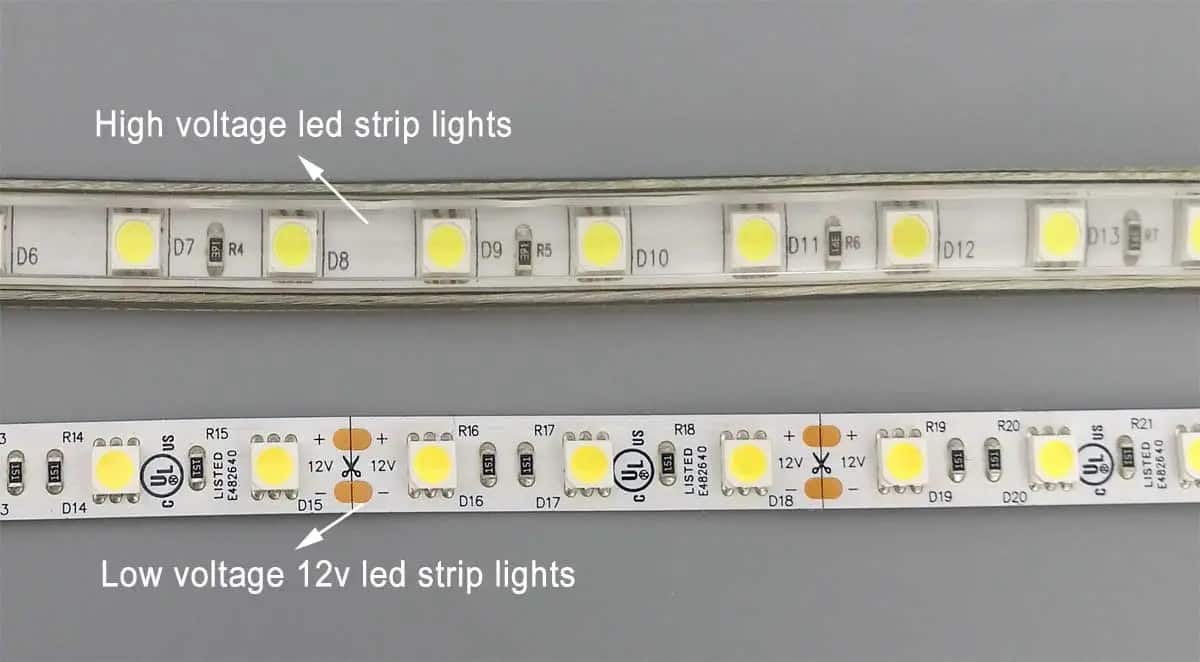
Voltage: 12 V or 24 V DC, with a power supply, the best choice for the home, or high-voltage strips, which run on mains voltage.
Protection: IP20 for dry indoor spaces, and IP65, IP67 or IP68 for damp and outdoor areas.
The Anatomy of an LED Strip
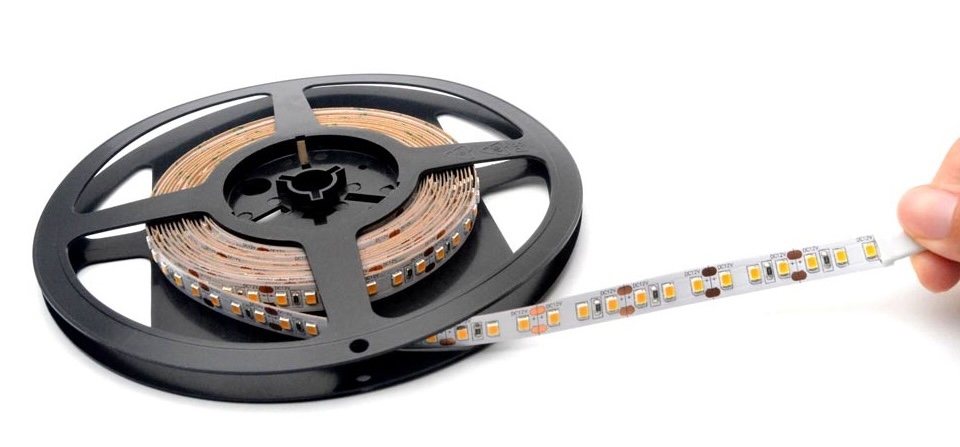
How wide is an LED strip?
An LED strip is usually between 8 and 12 mm wide and up to 10 meters long.
The 8 mm width is very common, including on COB strips, and strips with more wires, such as RGBW (5 wires) and RGBCCT (6 wires), tend to sit at the wider end of that range. Check the measurement on the datasheet before buying the aluminum channel and the connectors, which are made for each width.
The thickness of an uncoated strip is around 1 to 2 mm: in LEDVANCE datasheets, for example, an 8 mm COB strip is 1.7 mm thick, and a 10 mm tunable white strip, 1.2 mm. Silicone-coated strips, for damp areas, are thicker.
The 10 meter limit is not arbitrary: it exists because the strip has to be powered properly, to avoid voltage drop and dimmer light at the ends.
COB or SMD LED strip: what is the difference?
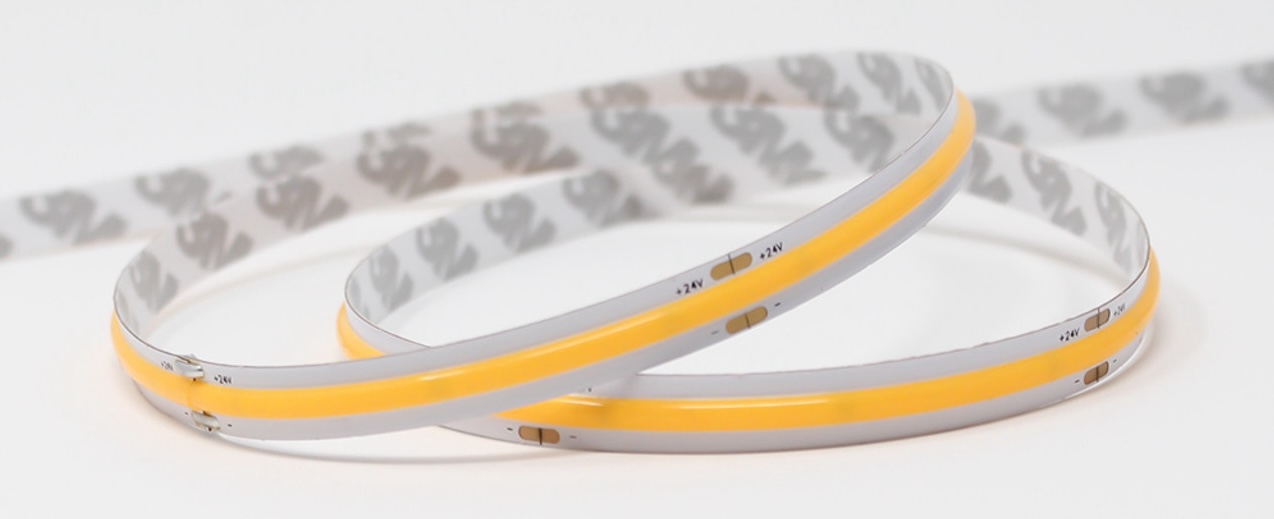
The difference lies in the number of LEDs per meter and in the effect of the light. On a COB strip, the LEDs are so close together that the light comes out continuous, with no dots: that is what a continuous LED strip is. On an SMD strip, the LEDs are spaced apart and show up as dots of light when the strip is in view.
The LEDs are mounted along the strip, at different densities depending on the technology used.
SMD strips usually have 60 to 140 LEDs per meter, while COB models have a density of 336 to 528 LEDs per meter.
SMD (Surface Mounted Device) technology has been the market standard, known for its reliability and the variety of options.
However, COB (Chip On Board) strips are quickly winning users over. They provide a continuous line of light, without the visible LED dots typical of SMD strips, with even illumination and a wider beam angle, and they also allow narrower, even more flexible strips.
The Brightness of LED Strips
The brightness of LED strips is measured in lumens (lm), the unit of luminous flux, in other words, the actual lighting capacity of a light source.
The higher the lumen value, the more intense the light emitted.
It is important not to confuse this measure with watts (W), which only indicate energy consumption.
Watts tell you how much the strip consumes; lumens are what determine its lighting power.
The most efficient LED strip is the one that delivers the most luminous flux for the least energy consumption, that is, more lumens per watt (lm/W).
For an accurate assessment, look at the lumens per meter (lm/m). For example, an LED strip rated at 1,500 lm/m provides roughly the same amount of light as a traditional T8 fluorescent tube.
The Color Rendering Index (CRI) is another crucial factor when choosing an LED strip.
This index, which ranges from 0 to 100, shows how well an artificial light source reproduces colors compared with sunlight (which has a CRI of 100).
An LED strip with a CRI above 90 will render the colors in a room very naturally.
The R9 value, which is specific to the rendering of red tones, also deserves attention when choosing.
LED Strip Models
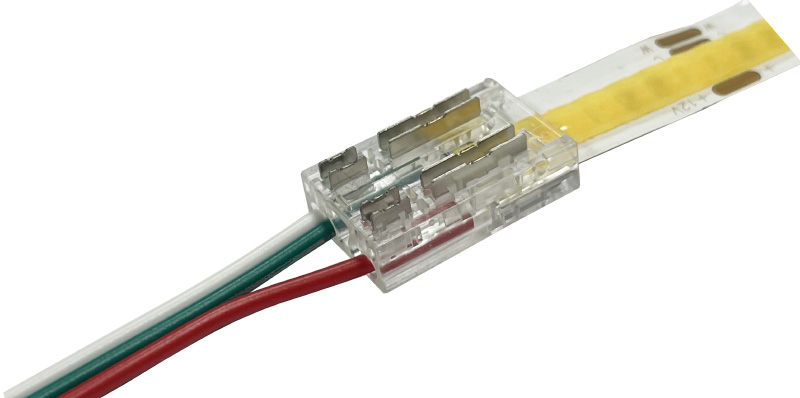
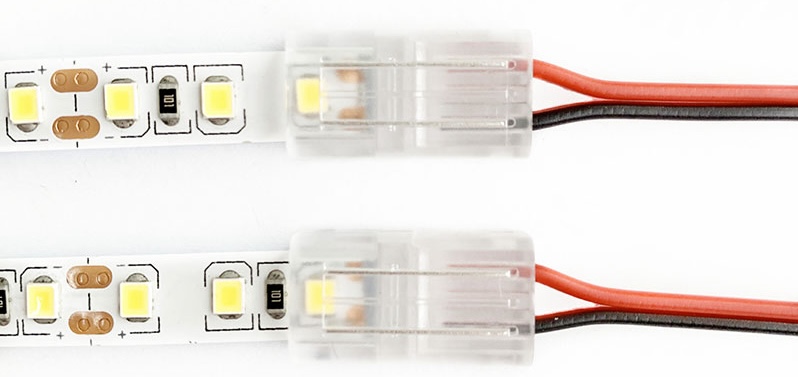
The most basic model is the 2-wire strip (Vcc and GND), which has a fixed color temperature and allows brightness adjustment through a PWM controller.
For those who value control over the tone of the light, CCT (Correlated Color Temperature) LED strips are excellent options.
With three wires, they let you adjust the color temperature from warm white (2,700 K) to cool white (6,000 K) and are ideal for spaces that need precise adjustments throughout the day.
Varying the color temperature is not just a matter of aesthetic preference: it can significantly affect our well-being.
Cooler lighting during the day helps regulate our internal clocks, promoting alertness and productivity, while warmer lighting at night helps us relax and get ready for sleep.
In the world of color, there are RGB, RGBW and RGBCCT strips.
Combining the primary colors (red, green and blue, hence RGB) makes it possible to create a wide palette of colors.
RGBW versions include a dedicated white channel, while RGBCCT versions combine RGB capabilities with adjustable white color temperature.
Types of SMD LEDs
LED chips are identified by numeric codes that indicate their dimensions.
For example, the SMD 5050 is 5.0 mm wide by 5.0 mm long and contains three chips in each unit, which makes it common in RGB or RGBW strips.
The 2835 chip (2.8 mm x 3.5 mm), on the other hand, stands out for its energy efficiency and higher brightness compared with earlier models.
Power and Control
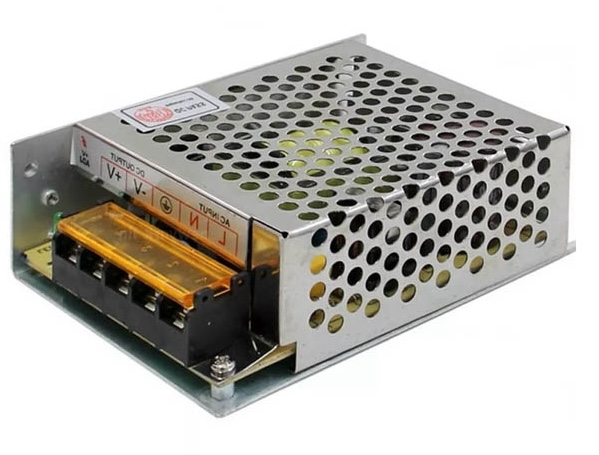
Choosing the power supply is crucial for LED strips to work properly.
Although there are alternating current strips (100 to 240 V AC), direct current strips (12 V or 24 V DC) are the most recommended for residential use, because they offer low consumption, precise control, steady brightness and safety.
Sizing the power supply correctly is essential.
How many watts per meter does an LED strip use?
It depends on the model: the power is listed on the datasheet in watts per meter (W/m) and generally goes hand in hand with brightness, meaning the more lumens per meter, the more watts. A 24 V COB LED strip with 528 LEDs per meter, for example, draws 14 W per meter, and a LEDVANCE tunable white strip rated at 1,700 lm/m draws 21.6 W/m.
For a 5 meter reel of the COB strip in the example, the total consumption will be 70 W, which requires a current of about 2.9 A (70 W divided by 24 V).
It is recommended to add a safety margin of at least 20% when choosing the power supply, which in this case means a 3.5 A or even a 5 A supply.
Power supplies with headroom run at lower temperatures, which extends their lifespan.
So does an LED strip use a lot of energy? The math is power times the time it stays on: the same 70 W, lit 5 hours a day, use 0.35 kWh per day, about 10.5 kWh per month. To find out how much that adds to your electric bill, multiply by your utility's price per kWh.
How to wire LED strips in parallel
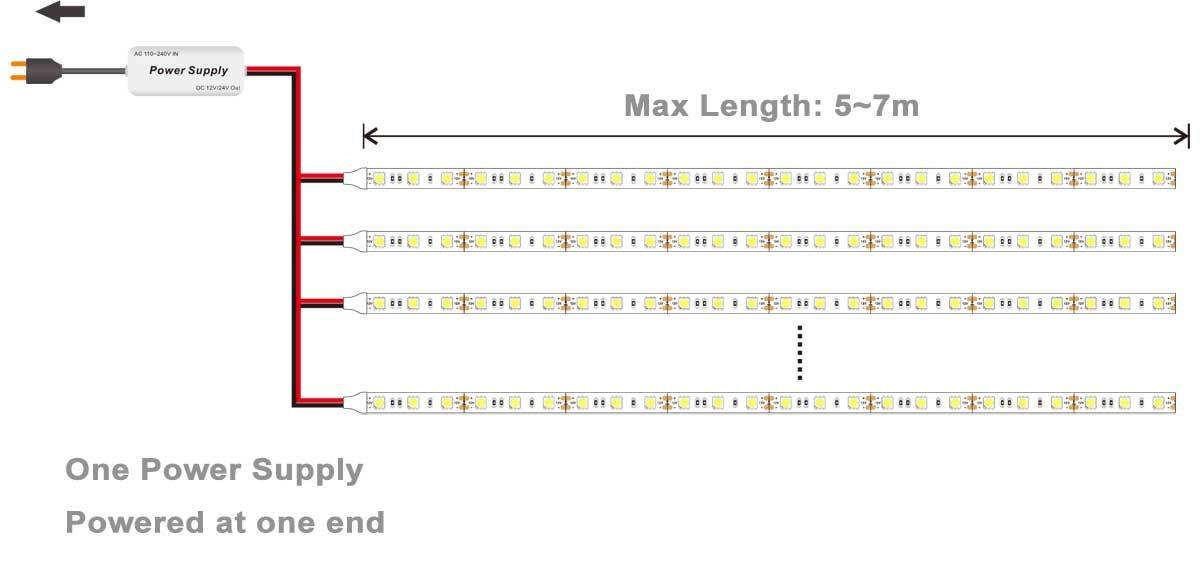
LED strips should be wired to the power supply in parallel, so that they all receive the same voltage.
In practice, each run of strip gets its own pair of wires from the power supply, positive to positive and negative to negative, instead of being spliced onto the end of the previous run, which would add up the lengths and the voltage drop.
On long runs, feed the strip from both ends or split the run into shorter sections, each one connected to the power supply. That way, the end of the strip is not dimmer than the beginning.
Controllers: brightness, colors and automation
Controllers, or drivers, are responsible for adjusting the brightness and colors of LED strips.
Even though dimmable power supplies exist, it is best to use dedicated LED controllers which, in addition to dimming, allow integration with automation systems and precise control of color temperature and colors.
With a Wi-Fi or Zigbee controller, the strip shows up in the app and in voice assistants, with scenes and schedules.
Installation and Care
To make installation easier, manufacturers apply double-sided tape to the back of the LED strip.
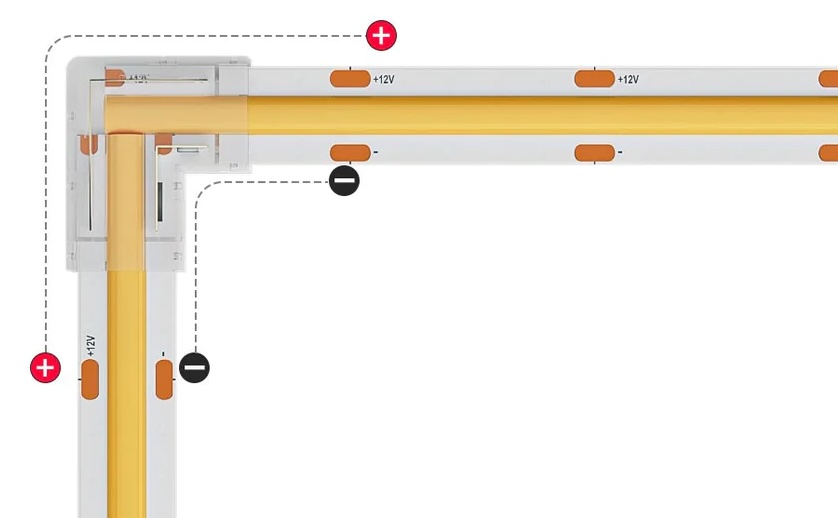
The flexibility of the circuit board allows mounting on curved and uneven surfaces, although 90-degree bends and splices need special attention.
Heat dissipation is a crucial aspect of installing LED strips.
The natural heating during operation can shorten the product's lifespan if it is not well controlled.
Aluminum channels are essential both for heat dissipation and for a clean finish on the installation.
For direct lighting installations, COB LED strips are the better choice, due to their higher LED density and continuous light, which avoids the visible dot effect common in SMD strips.
In outdoor or damp areas, also check the strip's degree of protection, the IP code from the IEC 60529 standard. An IP20 strip has no protection against water and is meant for dry indoor spaces. IP65 is protected against dust and water jets. IP67 withstands temporary immersion (up to 1 meter for 30 minutes), and IP68 is made to stay submerged, under the conditions specified by the manufacturer.
Quality and Specifications
The quality of an LED strip is directly related to the components used to make it. When choosing an LED strip, look for manufacturers that provide complete specifications, including:
Operating voltage
Power per meter and total
Luminous flux per meter and total
Detailed LED specifications
CRI and R9 value
Estimated lifespan
Operating temperature
Degree of protection (IP)
Warranty
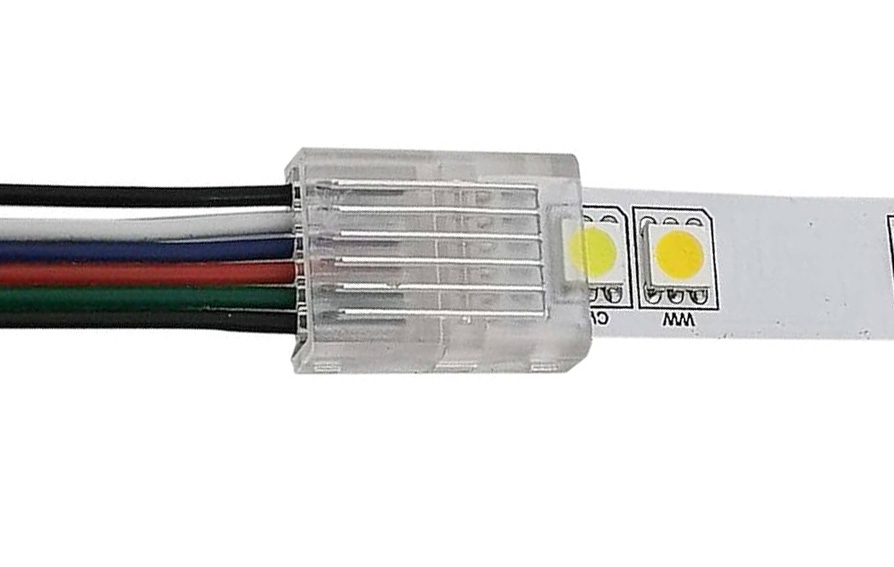
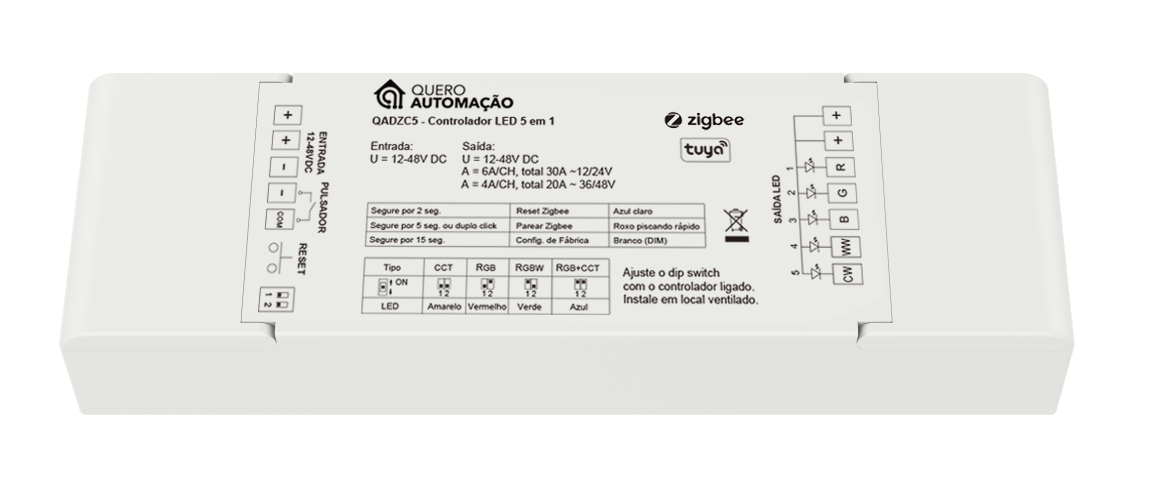
The same goes for the controller. In the image above, the label on the QADZC5, QA's Zigbee controller, shows the input voltage (12 to 48 V), the current per channel and in total, the compatible strip types (single color, CCT, RGB, RGBW and RGBCCT) and the wiring for each channel.
What is the best LED strip for the home?
The best LED strip is one with a complete datasheet that matches the use: there is no single strip that is right for everything. Here is the one to use in each case:
Main lighting: COB, preferably 24 V, with high luminous flux per meter (see below).
Coves, niches and furniture: lower-power SMD or COB, in single color or CCT.
Colors for parties and scenes: RGBW or RGBCCT, which produce colors and also a true white.
Bathroom, balcony and outdoor area: a strip with the IP rating suited to the moisture of the location.
Automation: a 12 or 24 V strip with a Wi-Fi or Zigbee controller, so it can be part of scenes and voice commands.
Can LED strips be used as main lighting?
Yes, as long as the strip delivers enough light for the room and does not cause glare. Use a COB strip with high luminous flux per meter and a CRI above 90, installed in an aluminum channel with a diffuser, in a cove or in a recessed slot in the ceiling.
The meters of strip and the lumens per meter for each room come from the lighting design, which takes into account the size of the space, the colors of the surfaces and how each room is used. With a CCT strip, you can also adjust the white throughout the day.
Conclusion
LED strips are much more than a simple lighting solution: they are versatile tools for transforming spaces.
The right choice depends on a careful analysis of the project, considering whether the application is direct or decorative lighting, the luminous flux needed and possible integration with automation systems.
Integration with smart systems, as in lighting automation, lets CCT LED strips automatically adjust the color temperature throughout the day, contributing to the well-being of the people who use the space.
On special occasions, the ability to add color to a space can create unique and surprising atmospheres.
Remember that, just as with automation, lighting requires technical knowledge for a successful project.
Consulting a specialized professional can be key to achieving the results you want in your lighting project.