February 4, 2020, 8 min read, by Vinicius Bastos
How to Automate Your Home Security, Step by Step
How to automate home security: smart lock, cameras, door and window sensors, smoke and gas detectors, phone alerts, and presence simulation.
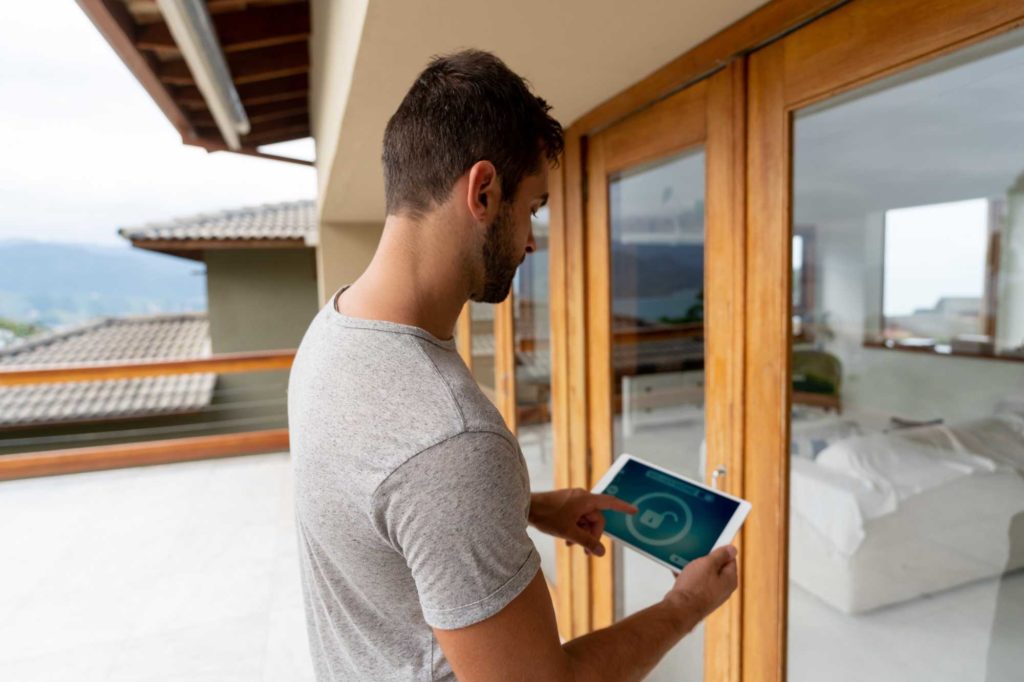
Little by little, home automation systems are being installed in Brazilian homes, as residents look for convenience and protection. However, Brazilians still have many questions about the benefits of this type of technology for their homes and about how automation systems work.
Is that your case too? Below, we show you how to automate your home security, step by step, and the advantages of using digital solutions to monitor your home. Keep reading to find out!
How to automate your home security, step by step
To automate your home security, start with the entrance, with a digital lock and a camera that sends alerts to your phone, and then protect doors, windows, and risk areas with sensors connected to a siren. Finally, bring everything together in scenes, such as a leaving-home scene, which locks the door, arms the sensors, and turns off the lights, and a vacation scene, which simulates presence.
Digital lock: opens with biometrics, a passcode, a card, or the app, creates temporary passcodes for guests and service providers, and logs who came in and when. To be part of the automation, it needs to speak the same protocol as your hub, such as Zigbee, Z-Wave, or Wi-Fi; the Matter standard has included locks since its first version, in 2022.
Cameras: at the entrance, in outdoor areas, and wherever there's something to watch, with cloud and memory card recording and notifications with an image on your phone.
Video doorbell: shows on your phone who rang the bell and lets you talk to the person from anywhere.
Contact and motion sensors: notify you when a door or window opens and set off the siren if the alarm is armed.
Smoke, gas, and water sensors: send alerts to your phone and can trigger the valve that shuts off the gas or water.
Scenes: the leaving-home scene locks the door, arms the sensors, and turns off the lights; the vacation scene turns on lights and opens curtains at different times, as if someone were home.
All of this depends on a stable Wi-Fi network. Connect the router, the internet provider's modem, the hub, and the cameras to a battery backup (UPS) so they keep working for a while during a power outage.
How does home automation improve home security?
For some time now, it has been hard to trust even the neighbors with the house key and ask them to "keep an eye" on things while the family is traveling. So how do you know everything is fine at home without someone you can trust?
Home automation was created to bring more comfort, convenience, and security to families. With this system, you can install security cameras and monitor your home from anywhere with internet access, for example.
These smart systems also make it easier to control access for people who come to your home. Instead of a door with a key lock, for example, you can install a digital lock, with biometrics, a passcode, or an app, and connect it to the security cameras. That way, it's easy to check who came in and out of your house during the day.
If there's any unauthorized access, the owner gets an alert on their smartphone and can watch what's happening.
Tips to keep your home secure
Automation lets you adopt some everyday practices to make your family safer. Here are a few:
schedule the lights to turn on even before you get home;
set up alerts from the security cameras or motion sensors in case there are strangers in your home;
use cameras with motion detection in different areas of the house;
install gas or water leak sensors so you're alerted to incidents;
open or close the curtains on days when no one is home too, to confuse burglars;
schedule the TVs to turn on at different times when you're not home, to create movement and noise in the house.
Digital security counts too
A connected home also needs to be protected on the network. Cameras, locks, and automation hubs are connected to the internet and, if poorly configured, can become a way in. A few simple practices help:
change the default password on your devices and router, and use a different password for each service;
turn on two-step verification in the apps that offer it;
always keep device firmware and apps up to date;
choose brands that keep publishing security updates for their products;
if possible, put your automation devices on a separate network, such as the router's guest network.
The issue has become so important that, in the United States, the White House announced a cybersecurity labeling program in July 2023, the U.S. Cyber Trust Mark, to help consumers choose certified and tested smart home devices. As of October 2026, the FCC, which runs the program, had not yet started accepting applications from manufacturers to use the label on their products.
How does home automation work?
Many automation systems work through control and monitoring from a smartphone, over an internet connection. Of course, there are some particulars, depending on the accessories used and the level of automation chosen for the home.
Residents can choose different features, depending on their needs. One of them is turning on the house lights from the phone. This can be done inside the home itself or from far away, as a way of simulating that there are people in the house.
Automation can also extend to electronic devices, such as TVs, sound systems, and air conditioners. There are also smart intercoms (video doorbells) that capture photos and videos of people who enter the home or who simply stop in front of the door. This makes it possible to control access and identify individuals in case of a break-in.
The technology can also be used to open and close curtains, light fireplaces, and film everyone who enters the home. So it's one more tool for taking care of your home security.
In general, anything connected to electricity can be automated. The installation project depends much more on each customer's needs and budget than on the technologies available to do the job.
Steps to automate your home
If you're interested in implementing home automation to keep your home secure and your family comfortable, just follow the guidelines below:
choose which features you plan to automate (curtains, air conditioning, security cameras, water and smoke sensors, audio and video);
decide which rooms will have automation, but prepare the infrastructure in all of them in case you decide to expand in the future;
learn about the main types of systems available to make your home automated and smart;
look for a specialized company to design your home's project (remember to check its references);
follow the installation and make sure all items are working properly;
require a warranty on the home automation project.
If possible, buy all the home automation equipment from the company you hire. That way, you can demand 100% quality in the service provided and in how the equipment works, because the company is responsible for the items it delivers.
What is the outlook for home automation in Brazil?
Brazil still has largely untapped investment potential in home automation. In 2015, according to the Brazilian Home Automation Association (Aureside), only about 300,000 homes had automation systems, in a country with 63.3 million households (IBGE data), and the potential market was at least 1.8 million homes.
For comparison: when this article was written, in early 2020, about 32.4% of American households were already using automation systems in their homes, according to a Statista study. The projection was for that share to reach 52.4% in 2024, thanks to the conveniences these technologies bring to residents and to home security.
In Brazil, the picture is changing, and many buildings are already being launched on the market with home automation as part of the offer. In São Paulo, for example, in 2019 many buildings were already smart, because the cost of this technology was falling.
Many builders are including electronic lock systems and lighting control by phone in their buildings. Others went further and included alert systems that report technical faults in elevators, as well as the option of adding automation to climate control and to closing the windows.
And the market keeps growing. According to IMARC Group, the smart home market in Brazil reached US$ 3 billion in 2025 and is expected to reach US$ 7.1 billion in 2034. Cameras, digital locks, and remote monitoring make up one of the segments tracked by the study. We talk more about this in the post on the growth of the automation market in Brazil.
In short, there are still few homes with automation systems, but the outlook is for that number to grow every day. That's because the project brings comfort to residents, adds value to the home, and also keeps it secure.
Did you like our tips? Take the opportunity to share this article on your social media and help other people keep their homes secure!